From Dialogue to Action: GTIN Introduces the “GTIN Civic Bridge Innovation” Through a Stakeholder Inception Meeting in Northern Uganda
Written By: Christopher Ofwono
(Field Operations Manager)
In August 2026, the Global Tech Inclusion Network (GTIN) Innovations Team travelled to Northern Uganda, to officially introduce and commence implementation of its Digital Democracy Initiative in Sub-Saharan Africa (DDISA)-supported project,
“Enhancing Citizen Engagement in Northern Uganda Through Digital Technologies for Improved Transparency and Accountability in Governance.”
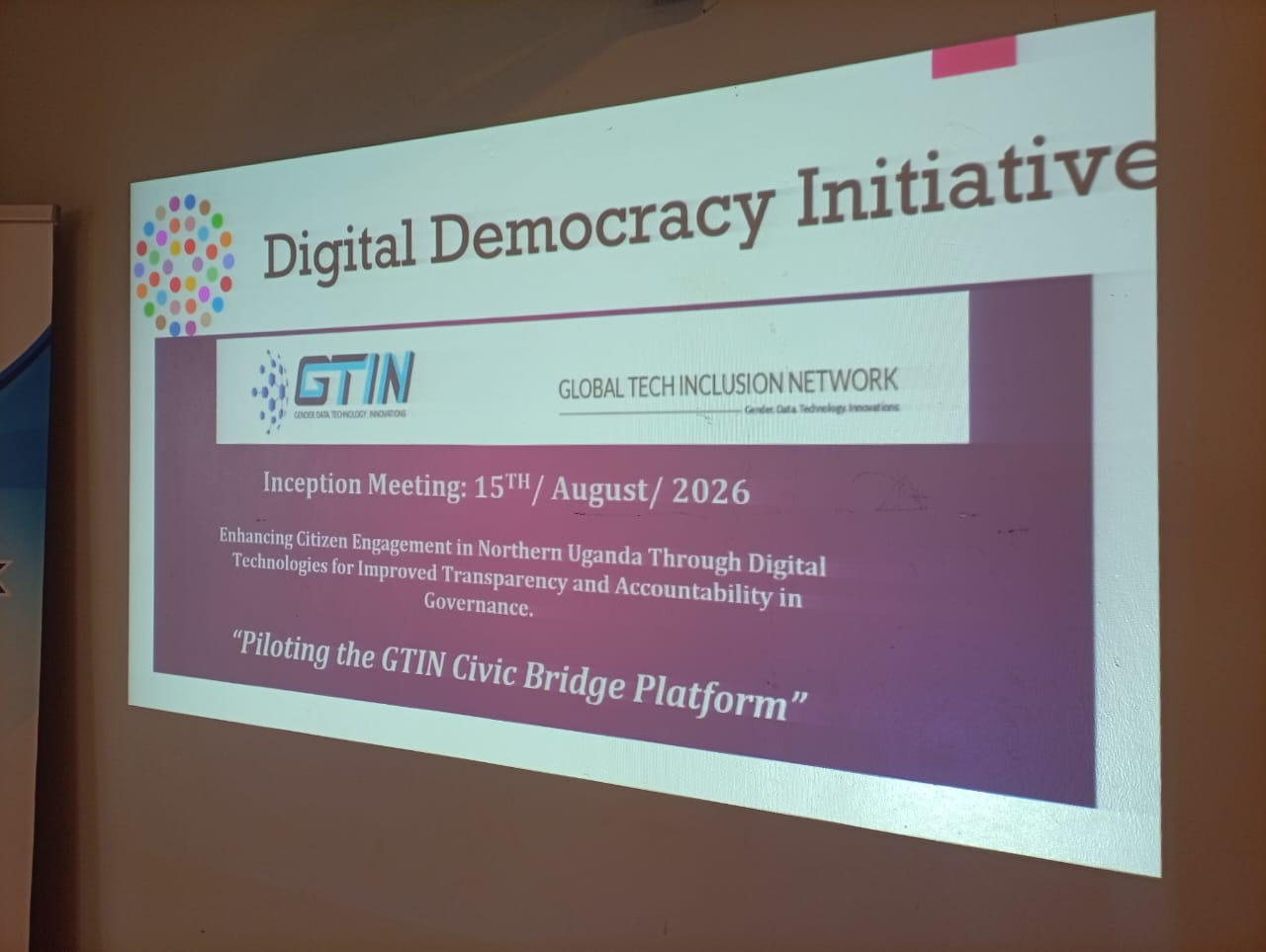
The inception meeting marked an important first step in bringing together community leaders, local stakeholders, and community members to understand the project's approach, discuss its objectives, gather feedback, and build the ownership and partnerships necessary for successful implementation.
At the heart of the project is the GTIN Civic Bridge Platform, an inclusive civic-tech innovation designed to establish a two-way communication channel between citizens and duty bearers. The platform seeks to enable and amplify action for civic space and inclusive democracy by creating multiple pathways through which citizens can make their voices heard, raise concerns, and engage meaningfully with those responsible for public service delivery.
Putting Citizens at the Centre of Governance
The GTIN-DDISA-supported project seeks to strengthen digital citizen engagement, transparency, accountability, and responsiveness in public service delivery, contributing to improved democratic governance in Northern Uganda.
The Civic Bridge Platform will enable citizens to report service delivery concerns, submit queries and complaints, and receive timely official feedback through a centrally controlled database. Rather than simply providing a space for citizens to submit complaints, the platform is designed to create a closed-loop feedback mechanism in which concerns are received, routed to the relevant duty bearers, followed up, and responded to.
This approach is intended to help bridge the gap between citizens and public institutions while demonstrating that citizen feedback can translate into meaningful action.
Designing Inclusive Technology for Communities
A key principle guiding the GTIN Civic Bridge Platform is that technology must respond to people's realities. Many rural communities in Northern Uganda continue to experience limited internet connectivity and varying levels of digital literacy. At the same time, feature phones remain widely used, making smartphone-only solutions unsuitable for many citizens.
The platform will therefore be accessible through web and mobile interfaces and designed to function in low-connectivity environments. It will integrate USSD and SMS, enabling people to participate using both smartphones and basic feature phones.
To address language and literacy barriers, the platform will support English and relevant local languages, with the possibility of expanding to additional languages and regions. Access will be free of charge to ensure that cost does not prevent low-income citizens from participating.
Inclusion, Safety and Privacy by Design
For GTIN, inclusive digital democracy must also be safe digital democracy. The Civic Bridge Platform will incorporate privacy and data protection measures to safeguard citizens, including the ability to submit reports anonymously where revealing one's identity could create risks or expose individuals to retaliation. Particular attention will be given to women and other vulnerable and marginalised groups who may face additional barriers to civic participation. The platform will use a simple, accessible, and gender-responsive interface to enable citizens with different levels of digital literacy to participate effectively.
From Complaints to Responses
One of the platform's most important features is its closed-loop feedback mechanism. Citizen complaints, queries, and reports will be captured through the platform and routed through a central database to the relevant duty bearers. Responses and actions taken will then be communicated back to citizens. This allows the project to move beyond merely collecting community concerns towards facilitating follow-up, responsiveness, and accountability.
Platform dashboards and analytics will also provide an overview of reported issues, response rates, unresolved cases, and emerging service delivery concerns. This information can support evidence-based dialogue between citizens, local governments, and other duty bearers.
Beyond the Platform: Building Community Ownership
Technology alone cannot create sustainable civic participation. The project will therefore combine the Civic Bridge Platform with community mobilisation, awareness raising, and capacity-building activities.
These will include community radio talk show, ICT and digital literacy training, community and district engagement meetings, and stakeholder engagements with local government.
Community radio will play an especially important role in reaching rural populations, raising awareness about citizens' rights, explaining how the Civic Bridge works, and creating spaces for public dialogue.
The project will also establish Voluntary Social Accountability Committees (VSACs) to support community members in submitting complaints, following up on unresolved concerns, and engaging duty bearers on service delivery issues.
Creating a Culture of Responsive Governance
The engagement meetings will provide opportunities for citizens and duty bearers to review platform data, dashboards, unresolved cases, and emerging service delivery trends. These engagements will encourage duty bearers to respond publicly to citizen concerns and demonstrate progress in addressing identified challenges. Social media will further complement the intervention by amplifying citizen voices, sharing key findings, and creating additional spaces for dialogue around inclusive and accountable governance.
The inception meeting therefore represented more than the introduction of a new technology. It was the beginning of a shared conversation about how citizens, communities, technology, and public institutions can work together to strengthen local democracy.
Ultimately, GTIN aims to contribute to a more responsive and participatory service delivery environment in Northern Uganda, one where citizens have accessible and safe mechanisms to make their voices heard, and where duty bearers have structured channels to listen, respond, and act.
Through the GTIN Civic Bridge Platform, the project seeks to demonstrate a simple but powerful principle: when citizens are given meaningful opportunities to speak, and institutions are equipped and encouraged to respond, technology can become a bridge between communities and accountable governance.